Program Development
Learning Design
How the WoW was conceptualized and designed with intention
Intentional Learning Design
The WoW team approached learning design as its own discipline, not as an afterthought to content. Every course, whether delivered onsite or virtually, was tested and refined across cohorts to serve a highly diverse group of MSF supervisors. Below are the core design principles that informed the development of all WoW programs.
Design Principles
Inclusive & Iterative
Every course in both onsite and virtual formats went through an inclusive, iterative design process. WoW "Pods" made up of designers and facilitators were created to review participant survey results, test and refine learning activities, and review individual modules to ensure programs were consistently delivered and that learning objectives were achieved.
Dual-Audience Design
The design process served two distinct audiences, with materials developed to give each what they needed to succeed.
Participant Materials
Presentations, module journals, instructions, activity materials and resources were created for participants to use and reference before, during, and after attending WoW programs.
Facilitator Materials
Lesson plans, activity notes, and reference guides gave WoW facilitators the structure, timing, and framing needed to deliver a consistent experience regardless of who was leading a session.
Cross-Referencing
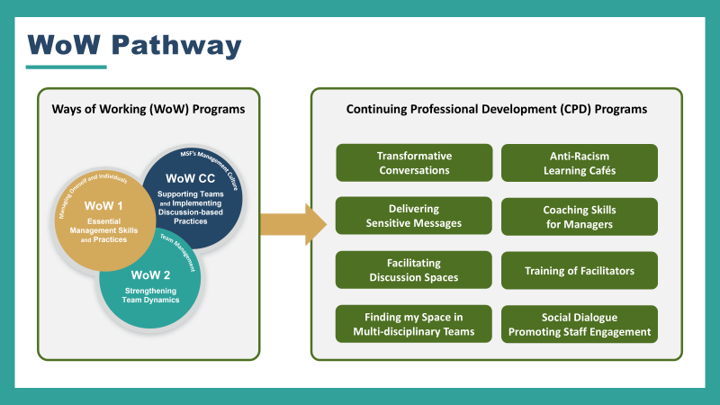
Cross-referencing reinforced the layering and callbacks across modules and across programs, connecting core content across WoW and Continuing Professional Development (CPD) offerings. This approach gave WoW participants multiple and recognizable entry points into the same ideas instead of a single linear path.
Design Forward
The team built every course around a principle we called fantastication: the belief that beautiful design is not just decoration, but rather a critical and functional part of learning. Color, iconography, and layout worked as learning cues that kept learning messages clear, consistent, and direct. This helped WoW facilitators and participants stay oriented inside the content and focused on what mattered most at any given moment.
Accessibility
Accessibility was grounded in Universal Design for Learning (UDL), giving participants multiple ways to access, engage with, and demonstrate understanding of content rather than a single fixed path. All core materials were produced in both physical and digital formats. Additionally, they were developed in English and French, MSF's working languages, with subtitles and transcripts accompanying video content, so participants could engage in the language and format that worked best for them.
Slow Learning
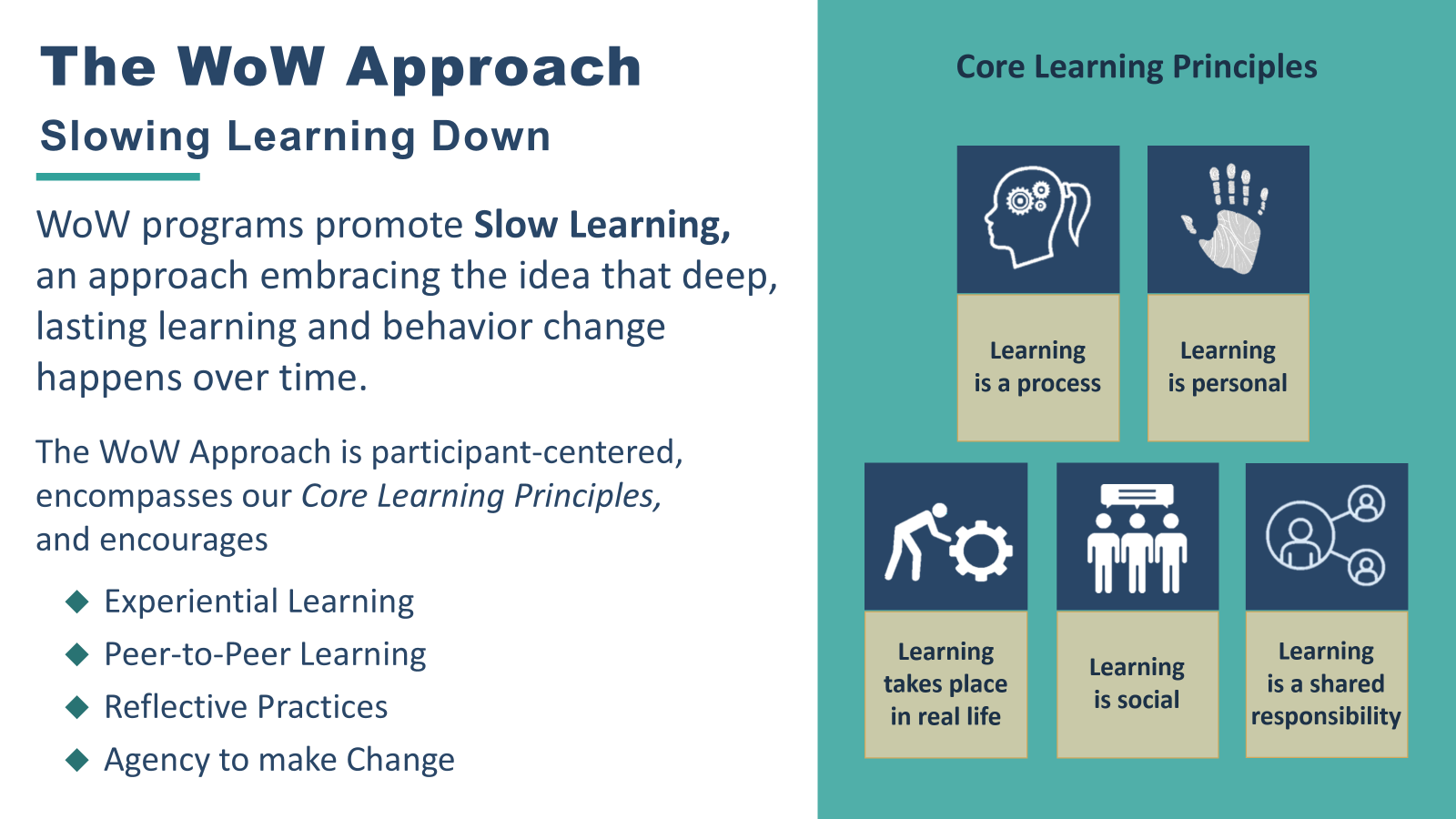
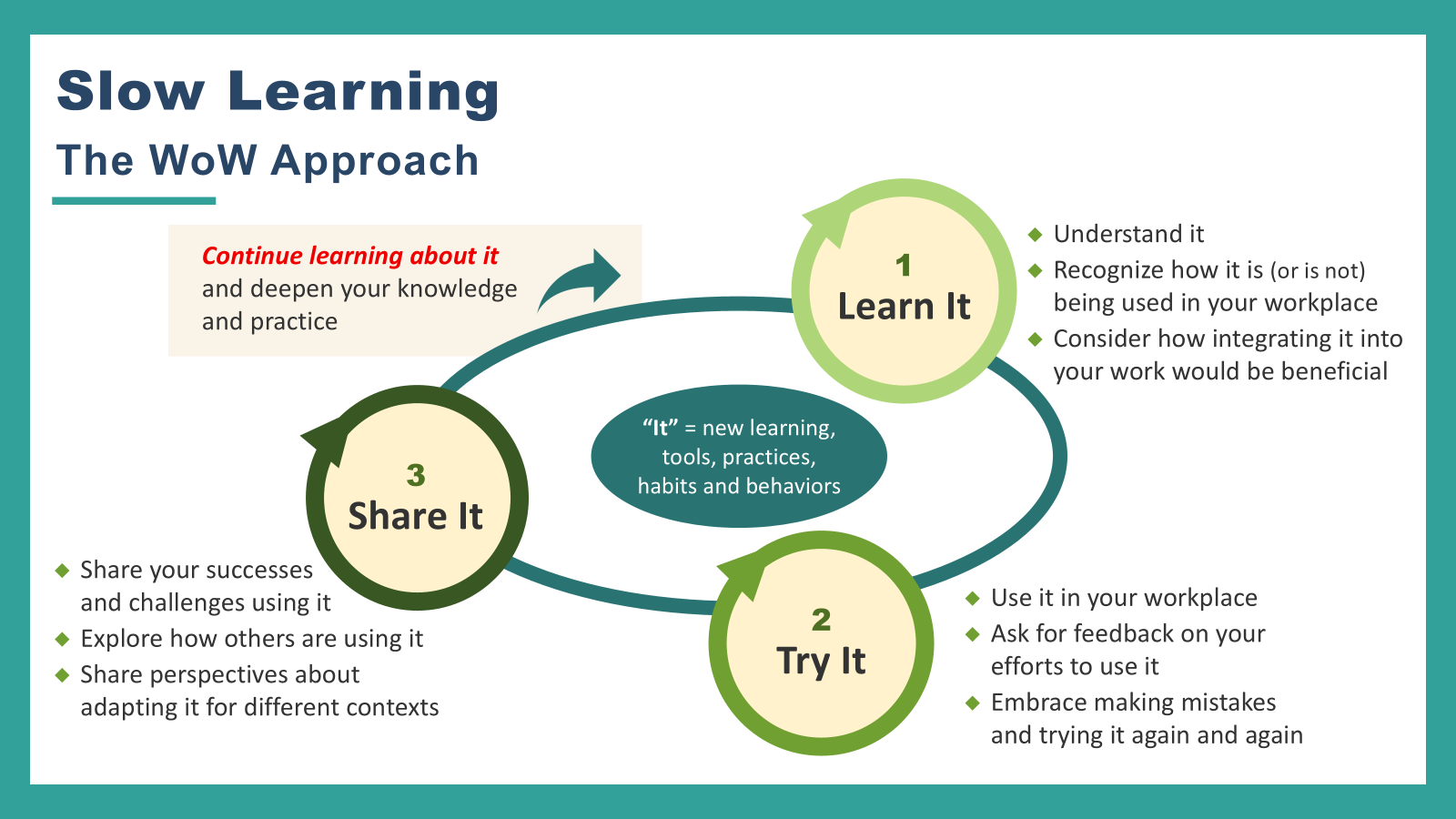
Slow Learning, introduced as the foundation of the WoW approach to learning, shaped not just program philosophy but day-to-day design decisions: what activities to build, how sessions were facilitated, and how much room was left for participants to think, apply, and return to an idea.
In practice, this meant designing around three implementation pillars:
Adult learning principles: Following adult learning theory (andragogy), courses were problem-centered rather than content-centered, connecting new material to challenges participants were already navigating at their projects, and respecting participants as self-directed learners who brought relevant experience into the room, not blank slates receiving information.
Peer-to-peer learning: Small-group discussions and cross-project sharing were built into the structure of every session, not left to chance. Participants brought different contexts and experience levels, and the design treated that diversity as content: participants learned as much from each other as they did from their facilitators.
Activity-based learning: Instead of lecture-style delivery, courses were built around case studies, scenario-based exercises, and simulations drawn from real MSF workplace challenges. Concepts were something participants worked through, not just heard as abstract ideas.
Together, these choices meant slowing learning down: trading content coverage for depth, and single presentations for repeated, varied engagement with the same core ideas.
Layering & Callbacks
The team designed materials in layers: pre-work, delivery, peer-to-peer learning, and deliberate callbacks that carried a topic forward across modules and programs. Topics introduced in one module would be brought back in later modules, ensuring participants and facilitators had multiple opportunities to consider and apply concepts and theories.
Module Journals
The team recognized that pre-work for virtual courses improved learning outcomes, but also recognized that participant schedules made completing it difficult. Over time, the WoW team developed Module Journals that balanced the volume of required pre-work while preserving core content as resources so participants could return to them as a reference after the training ended.
Reflective Practice
Reflective practice ran as a consistent thread throughout the curriculum, woven through activities and discussions rather than sitting as a single closing exercise.
Ultimately, the goal of the learning design process went beyond providing resources for any single course – it was the foundation of supporting participants in their journey to changing the management culture in their workplaces. The design principles sought to create a learning environment which modeled the management philosophy participants could seek to replicate in their own projects.
Through experiential, peer-to-peer learning, bolstered by a deep library of accessible tools and resources, participants were provided with a safe learning space to practice a new way of managing themselves and their teams. The process was not accidental but the result of deliberate, thoughtful choices based on sound learning methodology and continuous reflections after each program delivery.
Back to WoW Portfolio